

By Jake Slowinski, Co-Publisher
Here is something I did not know until I started asking more questions about custom drapery:
You can spend a lot of money on beautiful fabric and still end up with curtains that look flat.
Not bad. Not necessarily cheap. Just… underwhelming.
You know the look. The drapes are technically there. They cover the window. The color is right. The fabric may even be gorgeous.
Yet instead of soft, substantial folds, they hang more like two pieces of fabric parked on either side of the glass.
The reason may have nothing to do with the fabric itself.
It may be the fullness.
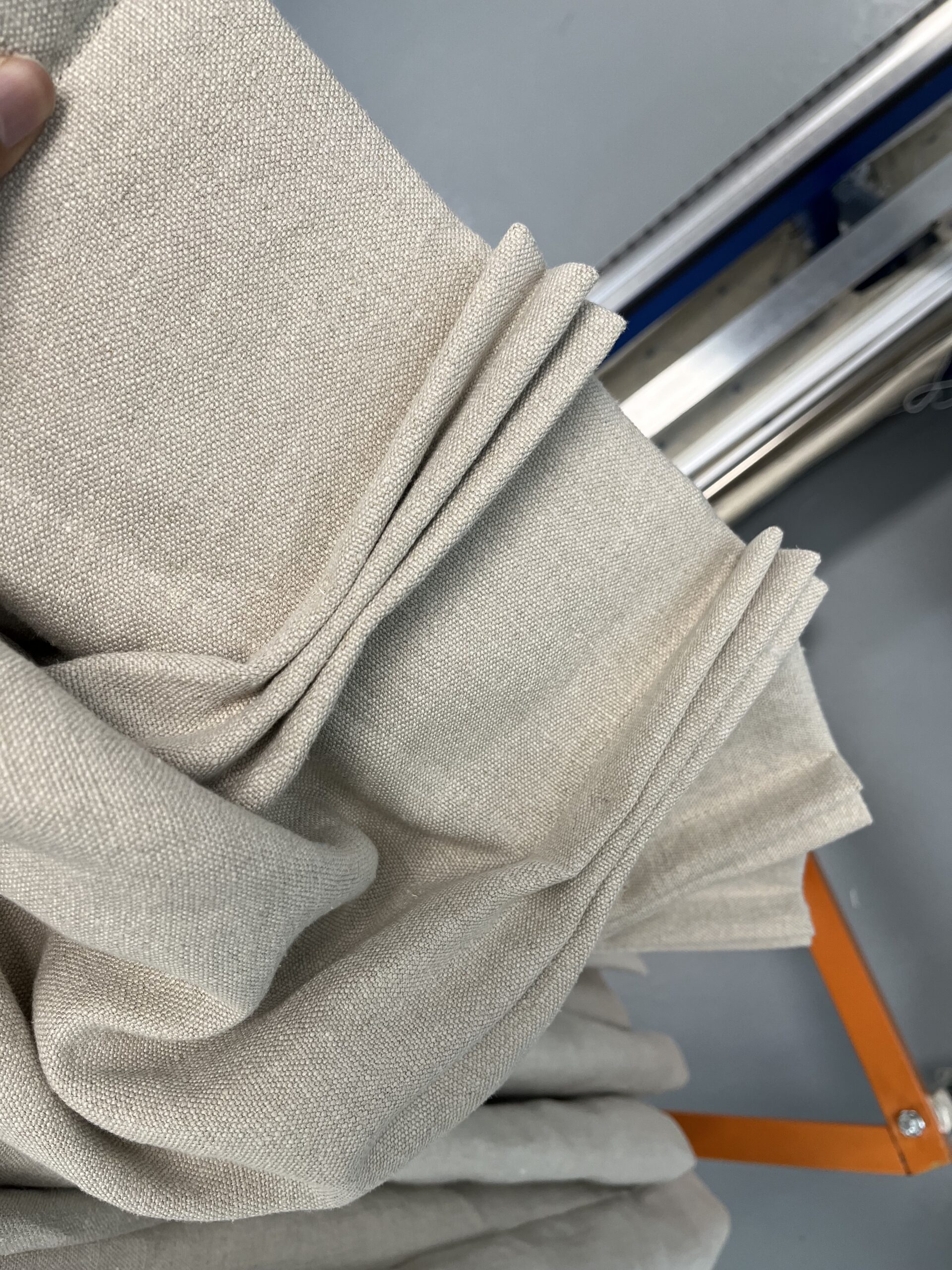
I recently talked with Nishan Madawala of Regal Drapes, a drapery workroom in Morristown, New Jersey, about the details homeowners should understand before ordering custom window treatments.
His explanation of fullness was probably the easiest one for me to immediately visualize.
“the fullness is how much fabric it would take to cover a window”
That sounds simple because it is.
Fullness is basically the relationship between the width of your window and the amount of fabric being used to cover it.
If you have a 100-inch-wide window and use 100 inches of fabric, you have enough fabric to stretch straight across that window.
That is it.
There is no extra material available to create those deep folds we associate with fuller drapery.
Picture hanging a bedsheet across a window.
It covers the opening. Mission accomplished.
It just does not look particularly luxurious.
The folds come from the extra fabric.
The math behind drapery fullness
Let’s stick with that 100-inch window because the numbers are easy.
A 100-inch window with 100 inches of fabric gives you a fullness ratio of 1 to 1.
In other words:
100-inch window
100 inches of fabric
1x fullness
Madawala describes the luxury benchmark he uses as at least two and a half times the window width. That is also the standard his own workroom builds to.
For the same 100-inch window, that would mean:
100-inch window
250 inches of fabric
2.5x fullness
Now there is an extra 150 inches of fabric available to form folds.
That is a very different finished look.
To be clear, 2.5x is not some universal drapery law. It is the benchmark Madawala described to me and the standard Regal Drapes uses in its own work.
Other workrooms may approach fullness differently depending on the fabric, design, heading style and project.
The important part for a homeowner is understanding that the amount of fabric matters.
A lot.
Let’s do the math on a few other windows.
Say your window or drapery span is 60 inches wide.
At 1x fullness:
60 x 1 = 60 inches of fabric
At 2x fullness:
60 x 2 = 120 inches of fabric
At 2.5x fullness:
60 x 2.5 = 150 inches of fabric
Now take a larger 144-inch span, which is 12 feet.
At 1x fullness:
144 inches of window
144 inches of fabric
At 2x fullness:
144 x 2 = 288 inches of fabric
At 2.5x fullness:
144 x 2.5 = 360 inches of fabric
That is 30 feet of fabric width being used across a 12-foot opening.
Suddenly the price difference between two drapery quotes starts making more sense.
You may not actually be comparing the same product.
One quote could be using significantly more fabric.
That does not automatically make it better. It does mean you need to know what is being specified before deciding one number is expensive and another is a bargain.
If you are comparing workrooms, our Custom Drapery Workrooms in New Jersey guide is a good place to start. Then ask every workroom the same fullness question so you are comparing apples to apples.
Why less fullness can look flat
Think about the curtains in a theater.
When they are closed, you still see folds.
That is because there is considerably more material there than the width of the opening itself.
Now imagine pulling that same fabric completely taut.
You would lose the movement, depth and shadow created by those folds.
Drapery works the same way.
Fullness creates shape.
It is the difference between fabric simply covering the glass and fabric becoming part of the room.
This is also why a photo of a gorgeous fabric swatch does not tell you what your finished drapes will look like.
Fabric selection is only part of the equation.
You also have to ask how much of it is being used.
Fabric changes the equation too
The exact look of fullness also depends on the fabric itself.
A heavy velvet and a lightweight linen are not going to behave exactly the same way even if both are made at the same fullness ratio.
Heavier fabrics may create deeper, more structured folds.
Lighter fabrics can look softer and airier.
Some fabrics hold their shape more naturally. Others move more.
That is where the workroom and designer come in.
You are not trying to become a textile engineer before buying curtains.
You just want to understand the variables well enough to ask an intelligent question.
And this is the question:
What fullness are you quoting me?
Not:
How many panels do I get?
Not:
How many yards of fabric is this?
Those can matter too. But fullness gives you a clearer picture of how much fabric is actually being allocated relative to the size of the window.
Ask for the ratio.
Is it 1.5x?
2x?
2.5x?
Something else?
Then ask why.
A good answer should connect the fullness to the specific fabric, heading style and overall look you are trying to achieve.
Why two panels are not always two panels
This is another place homeowners can get confused.
You may be told you are getting two drapery panels.
Fine.
How wide are they?
Two narrow panels and two generously constructed panels are both technically “two panels.”
They may look completely different once installed.
For example, on a 100-inch window, two finished panels totaling 100 inches of fabric give you essentially no extra fabric across the span.
Two panels totaling 250 inches give you much more material to form folds.
Same window.
Same number of panels.
Very different result.
This is exactly why I would never approve a custom drapery proposal now without asking what the fullness is.
It is one number that tells you a surprising amount.
What to ask before you order
If you want the shorthand version, take the width of the space you are covering and ask how much fabric width is being used.
Then divide.
If your window is 100 inches wide and the total fabric width is 200 inches:
200 ÷ 100 = 2x fullness.
If the total fabric width is 250 inches:
250 ÷ 100 = 2.5x fullness.
You do not need to do this while standing in the showroom with a calculator and a look of suspicion.
Although, frankly, I support that energy.
Just ask them to tell you.
Before you order, I would want answers to these questions:
• What fullness ratio is included in this quote?
• How much total fabric width will cover my window?
• Why did you recommend that amount for this particular fabric?
• Will the drapes still have visible folds when they are closed?
• If I am comparing two quotes, are both workrooms using the same fullness?
That last question may save you from making a decision based purely on price when the actual products are very different.
Because “custom” drapery is not just about picking a fabric and cutting it to fit your window.
How much fabric goes into that finished treatment changes how it hangs, how it folds and ultimately how it looks in your room.
If your curtains look a little flat, the problem may not be your taste.
You may simply need more fabric.
Jake Slowinski, co-publisher of Garden State Circle, was previously a partner in Regal Drapes. He holds no ownership interest in the company.