

By Jake Slowinski, Co-Publisher
There are certain words in home design that get thrown around so much they start to lose their meaning.
“Custom” is one of them.
A drapery panel can be made to fit your exact window dimensions and technically be a custom size. That does not necessarily mean it was constructed the way you probably assume a custom drape would be constructed.
And if you are about to spend real money on window treatments, that distinction matters.
I recently sat down with Nishan Madawala of Regal Drapes, a drapery workroom in Morristown, New Jersey, to talk about what homeowners should actually look for when someone tells them they are buying custom drapery.
His point was pretty simple: “custom doesn’t just mean a custom size”.
That got my attention.
Because most of us are not drapery experts. We choose a fabric. Someone measures the windows. We discuss pleats, length and hardware. Then a quote arrives with enough commas in it that we assume everything behind the curtain, literally, is being done a certain way.
Not always.
Madawala walked me through three construction details that homeowners can actually see, touch and ask about before placing an order. None requires you to know anything about sewing. You just need to know where to look.
Here are the three I would check.
1. Look at the front. You should not see the stitching.
Madawala’s first standard is straightforward: “blind stitching. There should be no stitching in the front”.
Blind stitching is exactly what it sounds like. The stitching used to construct the hem and seams is hidden so that when you look at the finished face of the drapery panel, you are looking at fabric, not a visible line of thread.
That might seem like a small detail until you see the alternative.
A workroom trying to produce panels more quickly can use a straight-stitch machine on areas where a blind stitch could be used. That sewing line may then be visible across the face of the drape.
More importantly, Madawala explained that the stitching itself creates tension.
Over time, that tension can show up as wrinkling or pulling along the seam. Instead of the fabric falling cleanly, you can begin to see where it was sewn. Hems can also start to ride up in places, creating an uneven line across the bottom of the drape.
This is one of those things I would never have known to inspect before this conversation.
Now I would.
If you are standing in a showroom looking at a sample panel, step back and look at the front in natural light. Then get closer. Look across the hem.
Can you see a line of stitching?
Does the fabric pucker around it?
Does the hem fall evenly?
You do not need to critique the craftsmanship like you are judging Project Runway. You just need to ask how the hems are sewn and then look at the panel yourself.
2. Check the bottom corners for weights.
The second detail is hiding inside the hem.
A properly constructed drapery panel can include small weights in the bottom corners. They are not decorative. They help the fabric hang the way it is supposed to hang.
This matters because your window is not exactly a climate-controlled museum display.
Sun hits it.
The temperature changes.
Fabric moves.
There is also natural tension created during sewing. Madawala explained that weighting the corners helps counteract those forces and keeps the bottom of the drape sitting where it belongs.
Think about the difference between a dress that hangs cleanly and one that constantly twists or pulls at the bottom. Same idea.
The goal is a hemline that stays crisp and even throughout the year instead of looking beautiful on installation day and slowly developing a mind of its own.
Again, this gives homeowners a very easy question to ask:
Are the hems weighted?
If they are, ask where the weights are placed. You should typically be able to feel them in the corners of a finished sample.
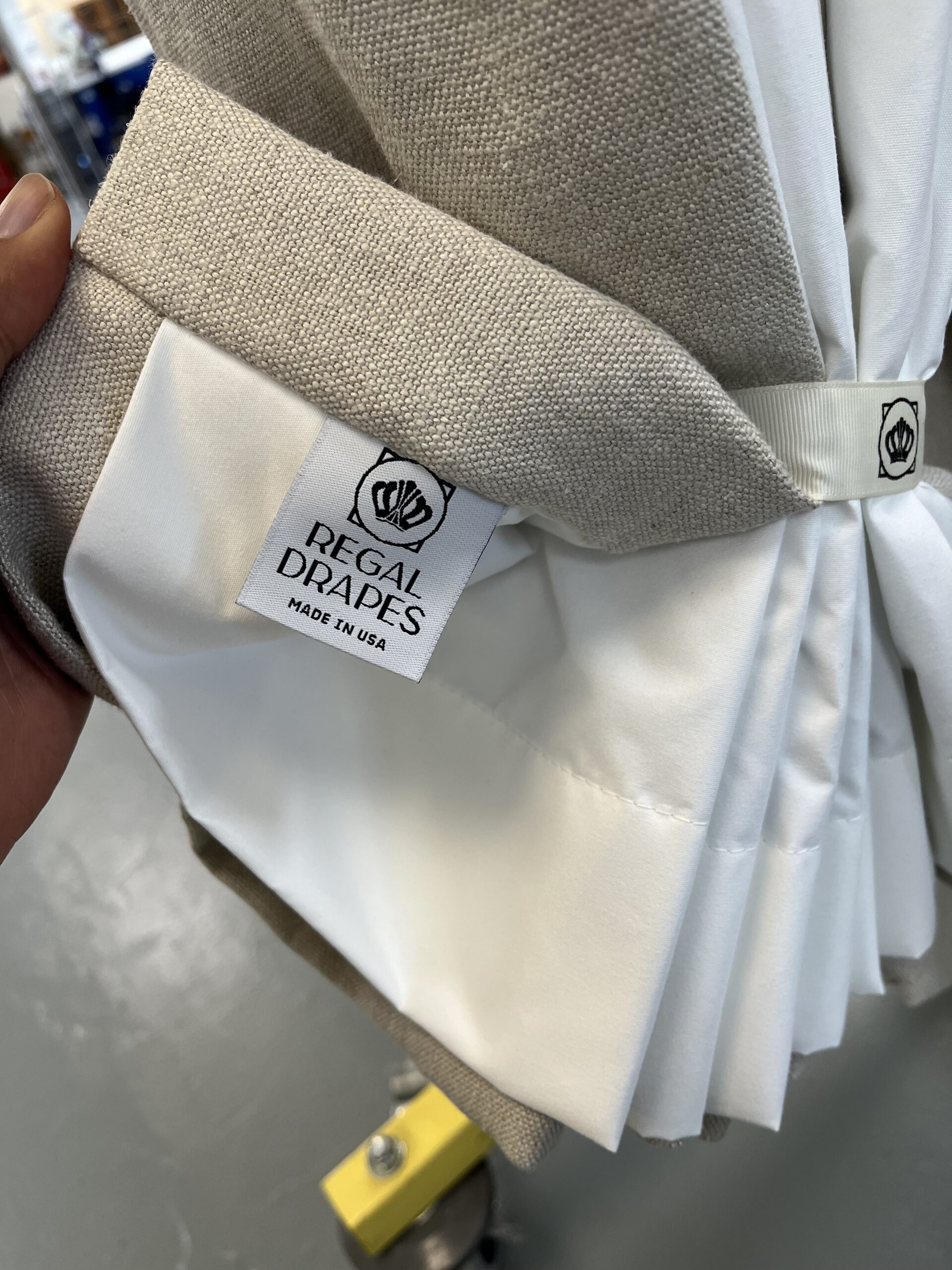
This is also why I would pay attention to construction details when comparing quotes instead of simply comparing the fabric name, dimensions and total price.
Two drapes can look very similar on an invoice while being constructed differently.
If you are shopping around, our Custom Drapery Workrooms in New Jersey guide is a useful starting point for finding workrooms and understanding what questions to ask before you commit.
3. Turn the drape around.
This may be my favorite test because it is ridiculously simple.
Look at the back.
Madawala put it this way: “the back of the drape should look as good as the front”.
Obviously, he does not mean the lining should look identical to your decorative fabric. He means the construction should look intentional and finished from both sides.
One detail to inspect is the header at the top of the panel.
Drapery headers often use buckram, a stiff material that helps give the top of the drape its structure and allows pleats and other heading styles to hold their shape.
In a fully finished panel, Madawala says that buckram should be tucked inside the construction rather than sitting exposed on the back of the drape.
Why should you care about something you may never see once the drapes are installed?
Because the back tells you a lot about how the whole thing was made.
It is the same reason you might look inside a cabinet drawer or underneath a piece of upholstered furniture before buying it. The parts nobody expects you to inspect can tell you quite a bit about the level of finish.
So turn the sample around.
Look at the header.
Look at the lining.
Look at the seams.
Does everything appear finished? Is the structural material contained inside the panel? Does the back look like part of the product or like the part nobody thought you would see?
Custom should describe construction, not just measurements.
That was really my takeaway from this conversation.
When you are buying drapery for an entire room, or an entire house, the investment adds up quickly. A homeowner should be able to understand where that money is going.
Yes, fabric matters.
Yes, the measurements matter.
Yes, the hardware and design matter.
The construction matters too.
And unlike some parts of the decorating process, these three things are pretty easy to verify.
You do not need to become an expert in drapery manufacturing.
Just turn into the slightly annoying customer who asks a few more questions.
I am very comfortable with that role.
Before you order custom drapery, check:
• Front of the panel: Ask whether the hems and seams are blind stitched. You should not see stitching running across the face of the drape.
• Hemline: Look for pulling, puckering or uneven areas around the seams and bottom hem.
• Bottom corners: Ask whether the drapes are weighted. Feel the sample if one is available.
• Back of the panel: Turn it around. The construction should look clean and intentionally finished.
• Header: Check whether the buckram is tucked inside the panel rather than exposed on the back.
Because if you are paying for custom, you should know what exactly is custom about it.
Jake Slowinski, co-publisher of Garden State Circle, was previously a partner in Regal Drapes. He holds no ownership interest in the company.