
About seven and a half years ago, my husband, Jake, walked into my office with an idea for what he thought I should do next with my life.
He had just come out of a business partnership that wasn’t working and was figuring out his next move. I had left guidance counseling and was working from home as a local mommy blogger, selling local advertising on my website. So when he announced that he had found a new business opportunity for me that he thought I would be great at, I wasn’t immediately receptive.
“Fantastic. I’m not the one looking for a job right now.”
The opportunity was a City Lifestyle magazine franchise, and he thought my journalism background and relationships with local businesses would make me a natural fit. I suggested he find a business he would be great at instead and sent him out of the room so I could get back to work.
Yes, I’m really fun to be around.
A couple of hours later, curiosity got the better of me, and I went looking for him. I wanted to see this magazine he was talking about. He started showing me videos, and by around 3 that afternoon, we were on a call with the franchise director.
We have never been accused of moving too slowly.
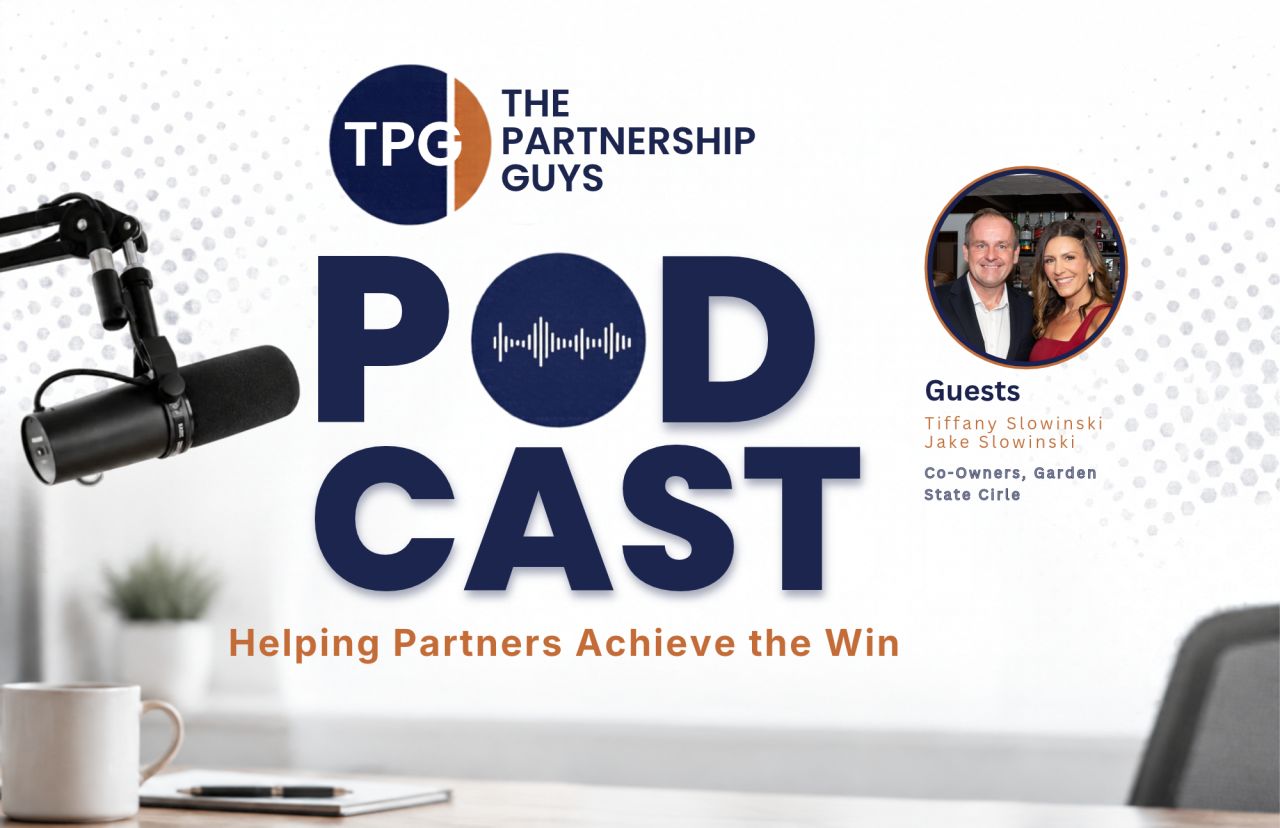
Recently, Jake and I shared that story on The Partnership Guys podcast with Steven Schneider, Todd Leonardis and Rob Stolker, three entrepreneurs we met through Entrepreneurs’ Organization New Jersey. We joined them to talk about building a publishing business together, raising three daughters and how much those two parts of our lives overlap.
The hosts help business partners work through communication, trust, expectations and conflict. Steven and Todd have been partners for more than 25 years, while Rob brings experience from partnerships that flourished and others that went painfully wrong. They understand how much the relationship between the owners affects everything around it.
Their questions took us from that first afternoon in my office to who gets the credit, who handles the details and whether we ever stop talking about work.
Looking back at the conversation, these are the five lessons that best explain how we’ve made it work.
1. Trust Leaves Room for Disagreement
At one point, the guys asked whether we would have chosen each other as business partners if we had met as strangers.
Honestly, probably not.
I’m impatient and outgoing. Jake is more reserved and generally more easygoing, although anyone who assumes that means he always goes along with me has clearly never watched him dig his heels in. When he really cares about something, I know I need to listen.
What we had before we ever sold our first magazine ad was years of knowing each other. We understood how the other person reacted under pressure, and we trusted that we were both trying to do what was best for our family.
That doesn’t prevent arguments. We’ve had plenty. Even when I think he’s going about something completely wrong, I know he wants the same things I do: a healthy business, a good marriage and a life that works for our family.
As I said toward the end of the interview, asking someone to trust you also requires behaving in a way that makes them want to. If every decision benefits you at your partner’s expense, eventually they’re going to start looking out for themselves, too.
2. Being Opposites Doesn’t Mean You Have Every Skill Covered
People look at our personalities and assume we must balance each other perfectly. I’m the outgoing one, so surely Jake is somewhere happily organizing spreadsheets and making sure every little detail is handled.
The truth is that we’re good at some of the same things, and we also avoid some of the same things. We both like ideas. We both like to delegate. Occasionally, we try to delegate work to each other, only to discover that neither of us was planning to be the person who actually did it.
Neither of us became wonderfully organized simply because the other one wasn’t.
Jake gave the guys a pretty honest description of what happens when he gets absorbed in something: His head can go into outer space for hours while people are still waiting for answers. Meanwhile, I’m very aware that those people are waiting. I’ll remind him, remind him again and eventually go into his email and deal with it myself.
We’ve built support around those gaps. Administrative help keeps communication moving, answers routine questions and gets people on his calendar when they need him. Clear processes help make sure the details don’t depend on whichever one of us happens to remember them.
Artificial intelligence has helped us organize our business, too. As we joked during the interview, Jake will even use Claude to capture our Saturday-night conversations because some of our best ideas come out while we’re sitting around talking. Apparently, he thinks I get especially creative after a drink.
The combination of people, processes and technology lets us work with who we actually are. Expecting either of us to wake up with a completely different personality hasn’t seemed like a particularly reliable business plan.
3. A Bad Result Doesn’t Automatically Mean Someone Did a Bad Job
Jake brought one rule into the business from the beginning: We could challenge each other on effort, but we weren’t going to punish each other for results we couldn’t control.
When your business involves sales, you hear “no” a lot. You can make the calls, have the meeting and follow up exactly as you should, and the answer can still be no. Coming home to a partner who makes you feel worse about it isn’t particularly motivating.
That conversation on the podcast brought us around to our daughter’s volleyball game. She was new to the sport, the score was close, and when the coach asked her to serve, she said no because she was afraid of making a mistake. The coach pulled her out, and she was upset about losing playing time.
I understood why she was nervous. I also wanted her to understand that refusing to try had consequences of its own.
Later, Jake helped her think through how to approach the coach and ask what she could work on to earn more time on the court.
It was the same conversation we might have after a difficult sales meeting. You can’t guarantee the outcome, but you can take responsibility for showing up, trying and learning something that helps you the next time.
4. The Person Getting the Applause Isn’t Doing All the Work
Jake told a story during the interview about going to corporate conferences in our early years and hearing people talk about how well I was doing.
“Tiffany’s amazing. Tiffany’s amazing.”
Meanwhile, he was standing right there.
“I’m here too.”
He admitted that it hurt, and I think that was one of the most honest parts of the conversation. I was out selling, meeting people and bringing in business, which made my contribution easy to see. He was running things behind the scenes and helping make sure the clients I brought in stayed with us.
He described eventually realizing that my success was good for our business and, therefore, good for him. There wasn’t much to gain by competing with it.
Of course, that also means I need to recognize what he contributes. Being the person people know doesn’t mean I built the business by myself. Bringing in a new advertiser matters, but so does taking care of that advertiser, delivering the work and giving them a reason to continue doing business with us.
5. Give Yourselves Permission to Change the Arrangement
Before we worked together, I was the default parent. I had taken time off with each baby, and Jake was working long hours in his previous business. That was the arrangement we had, and I was used to it.
Once we started the magazine, we began looking at our schedules differently. Jake hated networking events, and I didn’t mind them, so I would head to the chamber while he took the kids where they needed to go and made dinner.
This was a man who had never cooked dinner in our entire marriage, and now we were arranging our evenings around which networking event I was attending and what he was making.
He still does the grocery shopping and cooking, so I have no complaints about that particular development.
His version of the story was more meaningful. During the interview, he talked about working 70- and 80-hour weeks when our older girls were little and feeling like he had missed so much. With our youngest, Violet, he had another opportunity to be there.
We hadn’t sat down and planned that shift. It happened because we allowed our responsibilities to change instead of assuming they had to stay the way they’d always been.
The guys also asked about keeping work separate from our marriage, which is where we probably disappointed anyone hoping for a strict rule about never discussing business on date night.
When the girls were little, I remember Jake coming home and talking about his employees while I sat there thinking about how exhausting my day with the babies had been. At one point, I actually told him, “You are so boring.”
Now we can spend most of a Saturday evening talking about the business, the kids and whatever idea one of us wants to try next. Occasionally, we have to agree to leave a subject alone because we know it will take over the whole night.
Partnership can be hard, and being married doesn’t make every business conversation easier. It has also been incredibly rewarding to build something together, watch each other grow and understand what the other person is dealing with every day. After more than seven years of working together, we have more in common than we ever did before.
It helps that he makes dinner.
About The Partnership Guys
Based in Piscataway, New Jersey, The Partnership Guys helps entrepreneurs build, strengthen and work through challenges in their business partnerships. Steven Schneider, Todd Leonardis and Rob Stolker offer coaching, workshops and strategic advisory sessions for people considering a partnership, improving an existing one or navigating a transition. Their work addresses the conversations partners need to have about expectations, responsibilities, trust and the future of the business.
Their podcast brings those issues into candid conversations about what it takes to work well with other people, drawing on their own experiences as business owners and partners.
Explore their work at ThePartnershipGuys.com. You can find the podcast on Apple Podcasts, Spotify and YouTube under The Partnership Guys. Listen on Apple Podcasts or visit their YouTube channel.